Convert Centimeters to Feet & Inches (cm to ft)
Use our real-time calculator to convert lengths between metric and imperial units with accuracy.
Conversion updates instantly as you type.
What Type of Calculations Does a Length Converter Perform?
Meters to Centimeters
Converts metric scale factors. 1 Meter = 100 Centimeters (exact standard).
Centimeters to Feet & Inches
Translates metric height to imperial units. 1 Inch = 2.54 Centimeters exactly.
Kilometers to Miles
Converts travel and geographic distances. 1 Kilometer ≈ 0.62137 Miles.
Yards to Meters
Used for sports field measurements and textiles. 1 Yard = 0.9144 Meters exactly.
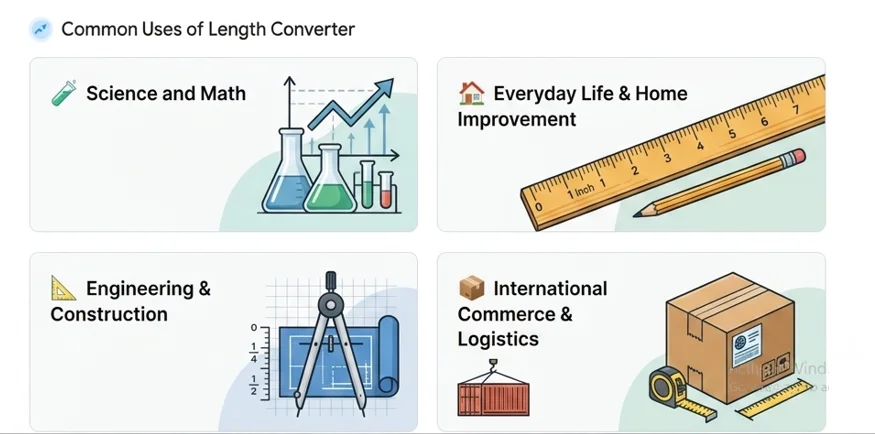
Common Uses of Length Converter
🧪 Science and Math
Used to measure precise distances between points and accurately calculate the dimensions, surface area, and perimeter of geometric shapes.
🏠 Everyday Life & Home Improvement
Essential for daily tasks such as tracking personal height, sizing furniture, cutting crafting materials, and converting room dimensions for decor.
📐 Engineering & Construction
Critical for translating architectural blueprints, converting metric structural specs to imperial job sites, and calculating material scale ratios.
📦 International Commerce & Logistics
Helps global shoppers and sellers convert parcel dimensions (inches vs. cm) to calculate dimensional weight and international shipping rates accurately.
Imperial to Metric Length Conversion Table
Quick reference for converting common imperial units to their metric equivalents.
| Imperial Unit | Metric Equivalent | Conversion Factor | Common Use |
|---|---|---|---|
| 1 Inch (in) | 2.54 Centimeters | × 2.54 | Screen sizes, small measurements |
| 1 Foot (ft) | 30.48 Centimeters | × 30.48 | Human height, room dimensions |
| 1 Yard (yd) | 0.9144 Meters | × 0.9144 | Sports fields, textiles, fabric |
| 1 Mile (mi) | 1.6093 Kilometers | × 1.6093 | Road distances, travel |
| 1 Nautical Mile (nmi) | 1.852 Kilometers | × 1.852 | Maritime & aviation navigation |
| 1 Rod (rd) | 5.0292 Meters | × 5.0292 | Land measurement, surveying |
| 1 Fathom | 1.8288 Meters | × 1.8288 | Water depth measurement |
| 1 Hand | 10.16 Centimeters | × 10.16 | Horse height measurement |
| 1 Centimeter (cm) | 0.3937 Inches | × 0.3937 | Reverse metric-to-imperial lookup |
| 1 Meter (m) | 3.2808 Feet / 39.37 Inches | × 3.2808 | Room dimensions, height |
| 1 Kilometer (km) | 0.6214 Miles | × 0.6214 | Road signs, running distances |
All conversion factors are based on international standards. Values are rounded for clarity.
100% Private & Secure: All conversions happen locally in your browser. No data is ever sent to a server.
Length Conversion Knowledge Test
Answer all questions, then check your score instantly. Nothing is sent anywhere — it's all scored right in your browser.
1 How many centimeters are in exactly 1 meter?
2 Which unit is typically used to measure maritime or air navigation distances?
3 How many inches are in 1 foot?
4 A kilometer is approximately how many miles?
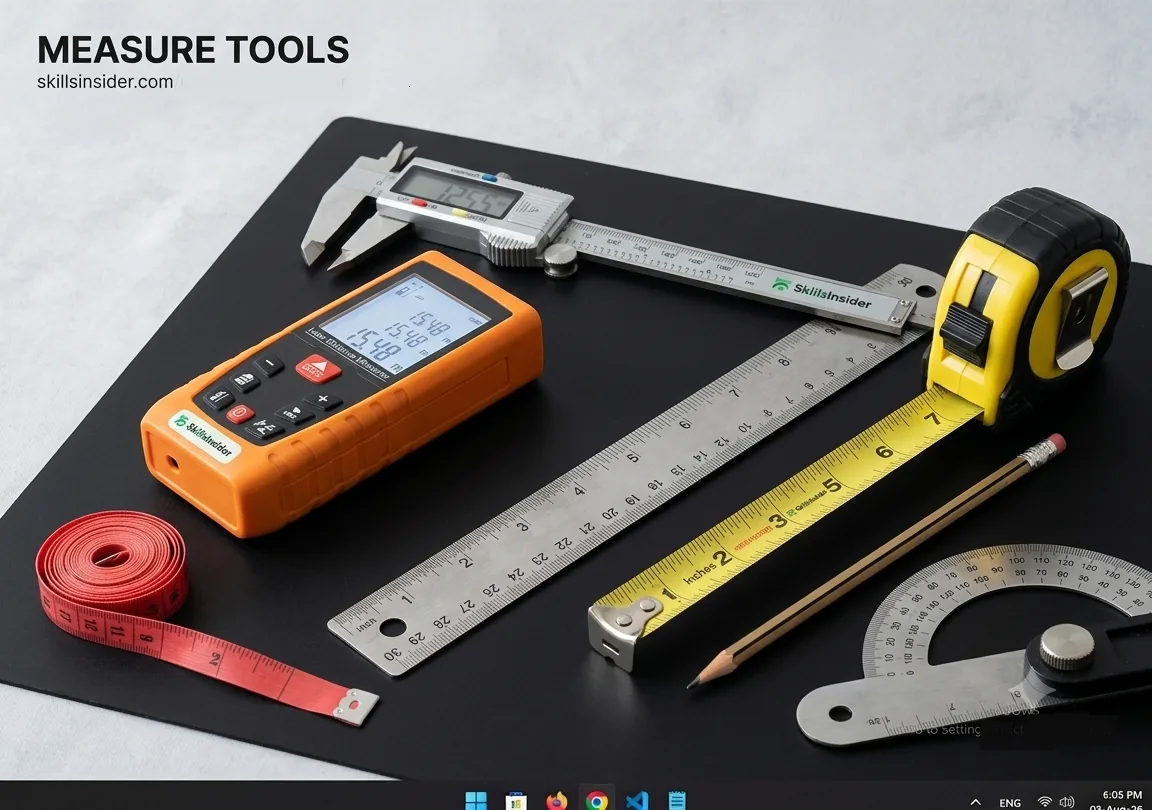
5 Which tool measures small parts to a fraction of a millimeter?
6 What is the exact metric equivalent of 1 yard?
How to Use This Length Converter
Getting a precise conversion takes about two seconds. Here is the short version:
- Enter the number you want to convert in the "From Value" field.
- Pick the source unit from the first dropdown — millimeters, centimeters, meters, kilometers, inches, feet, yards, miles, or nautical miles.
- Pick the target unit from the second dropdown.
- Read the result. The "To Value" field updates instantly as you type — no button press required.
All conversions are calculated by first converting your input to meters (the SI base unit for length), then dividing by the target unit's meter-equivalent factor. This ensures maximum precision regardless of which pair you pick — even obscure combinations like nautical miles to millimeters work perfectly.
Why Imperial and Metric Both Still Matter
The United States, Liberia, and Myanmar are the only countries that still primarily use imperial units for everyday measurement. Everyone else uses the metric system. That means if you work internationally — even occasionally — you will run into conversions.
Some common situations:
- Buying furniture online from overseas. Listings in centimeters or meters need to be compared with your imperial room dimensions.
- Running distances. Races are usually measured in kilometers internationally but in miles in the US. A "5K" is 3.1 miles.
- Reading product specs. Screen sizes are always measured diagonally in inches, even in countries that use metric.
- Traveling. Speed limits in Europe are in km/h; in the US they are in mph. 100 km/h is about 62 mph.
- Cooking. Some recipes use metric (grams, ml) and others use imperial (ounces, cups, inches for pan size).
- DIY and construction. Blueprints may be in either system, and lumber is still commonly sold in imperial dimensions worldwide.
Common Conversion Mistakes
- Mixing up inches and centimeters. A 12-inch ruler is 30.48 cm, not 12 cm. Always check the unit label carefully.
- Assuming feet are the same as "foot." They are — but the plural form is important in print. "5 foot 10" is informal; "5 feet 10 inches" is standard.
- Using miles instead of nautical miles. A nautical mile is about 15% longer than a statute mile. Navigation charts and aviation use nautical miles.
- Converting miles to km and back — and getting a different number. This is rounding error. 10 miles → 16.09 km → 10.00 miles is fine; anything more than 0.01 drift means one conversion was wrong.
- Forgetting about context. "5 feet" in height is very different from "5 feet" in a shipping box. Make sure you know what the number represents.
Why We Built This Tool
Most online length converters are packed with ads, take several seconds to load, or round aggressively in ways that lose precision. We built this one differently: it loads instantly, runs entirely in your browser (no server round-trips), and keeps up to 8 significant digits of precision.
We use it ourselves for shipping calculations, recipe adjustments, and reading international product listings. If you spot a bug, or you'd like us to add a new unit — like light-years, parsecs, or architectural units — drop us a note using the contact link below.

Frequently Asked Questions
Explore Related Unit Converters
⚖️ Weight Converter
Convert kg, lbs, grams, ounces, and stones instantly.
🧪 Volume Converter
Convert liters, gallons, ml, fluid ounces, and cups easily.
🌡️ Temperature Converter
Switch between Celsius, Fahrenheit, and Kelvin.
🏎️ Speed Converter
Convert mph, km/h, meters/sec, and knots.
⏱️ Time Converter
Convert seconds, minutes, hours, days, and milliseconds.
⏲️ Pressure Converter
Convert PSI, Bar, Pascal, Atm, and Torr units seamlessly.
⛽ Mileage Converter
Calculate MPG, L/100km, and km/L fuel efficiency metrics.